Border openings in Gaza: Turning words into action
Veröffentlicht am 5. April 2024
von Jonas Gruenwald
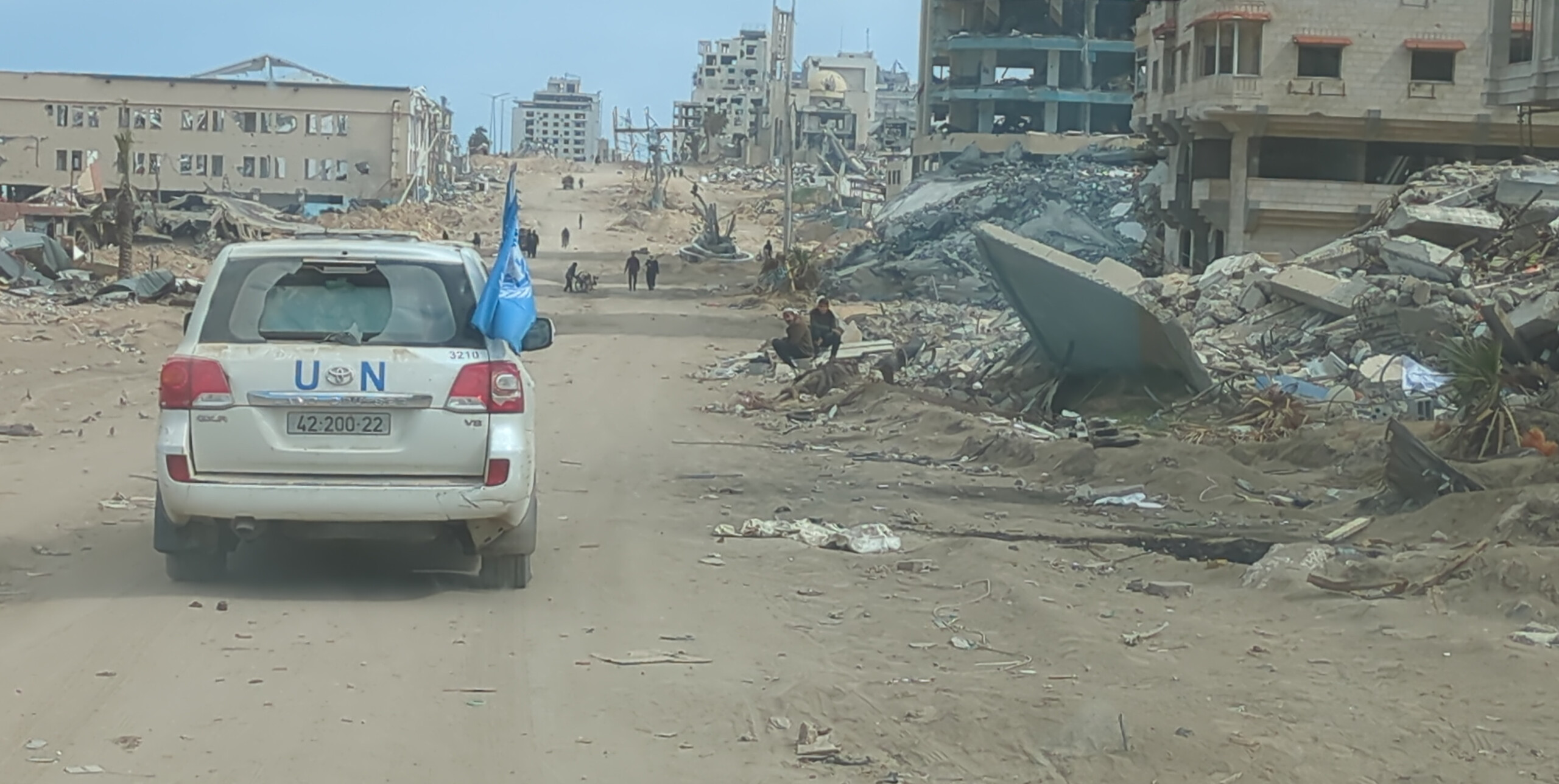
Auf einer Fahrt durch Nord-Gaza wird das Ausmaß der Zerstörung ersichtlich. Eine Grenzöffnung für humanitäre Güter könnte die Not abmildern. Foto: CADUS
We are delighted by the news of a planned opening of the border in the north and south of Gaza and thus the prospect of more humanitarian aid deliveries. At the same time, it is clear that this step is long overdue and that Israel must now quickly follow up its announcement with action.
The opening of the borders gives hope for an easing of the situation and an improvement in the supply of food, medicine, fuel and other essential goods. This could also eliminate the need for expensive, ineffective and dangerous transportation by air. For us, the opening of the borders could also reduce the risk of our medical transports from the north. The people there understandably take every opportunity to get food and approach our convoys in the hope of a little nourishment.
Despite the risks and several aborted attempts, our team continues to carry out medical transports, so-called MedEvacs, from North Gaza. Video: CADUS
Expectations of the border openings are high, but many questions remain unanswered: to what extent will transports be permitted and how quickly can they pass through the checkpoints? Will the border also be open out of Gaza, especially to allow medical transports?
Not least because of the deadly attack on the aid workers from World Central Kitchen, the Israeli army has lost the trust of humanitarian organizations in joint agreements. Announcements to open the borders “temporarily” do not allow for reliable planning. Trust can only be rebuilt through clear announcements, agreements and processes in order to enable effective humanitarian work. Humanitarian aid workers must be able to carry out their tasks with the certainty that they will not be targeted by the Israeli army.
We therefore demand:
- the creation of permanent humanitarian corridors with clear and transparent arrangements between the Israeli army and humanitarian actors, and
- the opening of borders for medical transports to enable seriously ill and seriously injured people to receive appropriate medical care!
Humanitarian aid is not a generous act of a state, but a human right protected by international rules! It is time for Israel to act accordingly.

Die Zukunft humanitärer Hilfe
Einen Text schreiben über die Zukunft der humanitären Hilfe. Mein erster Impuls: Das wird aber ein düsterer Text. Die Gegenwart der humanitären Hilfe lässt wenig Raum für Zuversicht. Kriege reißen nicht ab, im Sudan sterben Menschen unbeachtet von der Weltöffentlichkeit,
How AI Is Changing Humanitarian Aid: Risks and Opportunities
I’ve spent enough nights under mosquito nets and sat through long, often circular UN coordination meetings to know this: if we want to reach people in crisis faster, with less waste, and without burning out the sector, we can’t
Wie KI die humanitäre Hilfe verändert: Risiken und Chancen
Ich habe genug Nächte unter Moskitonetzen verbracht und lange, oft im Kreis drehende UN-Koordinationssitzungen durchgestanden, um eines zu wissen: Wenn wir Menschen in Krisen schneller erreichen wollen, mit weniger Verschwendung und ohne den gesamten Sektor zu überlasten, können wir