CADUS goes Interschutz: Why we exhibit rust and dents instead of high-tech
Published on 1. June 2026
from Sebastian Juenemann
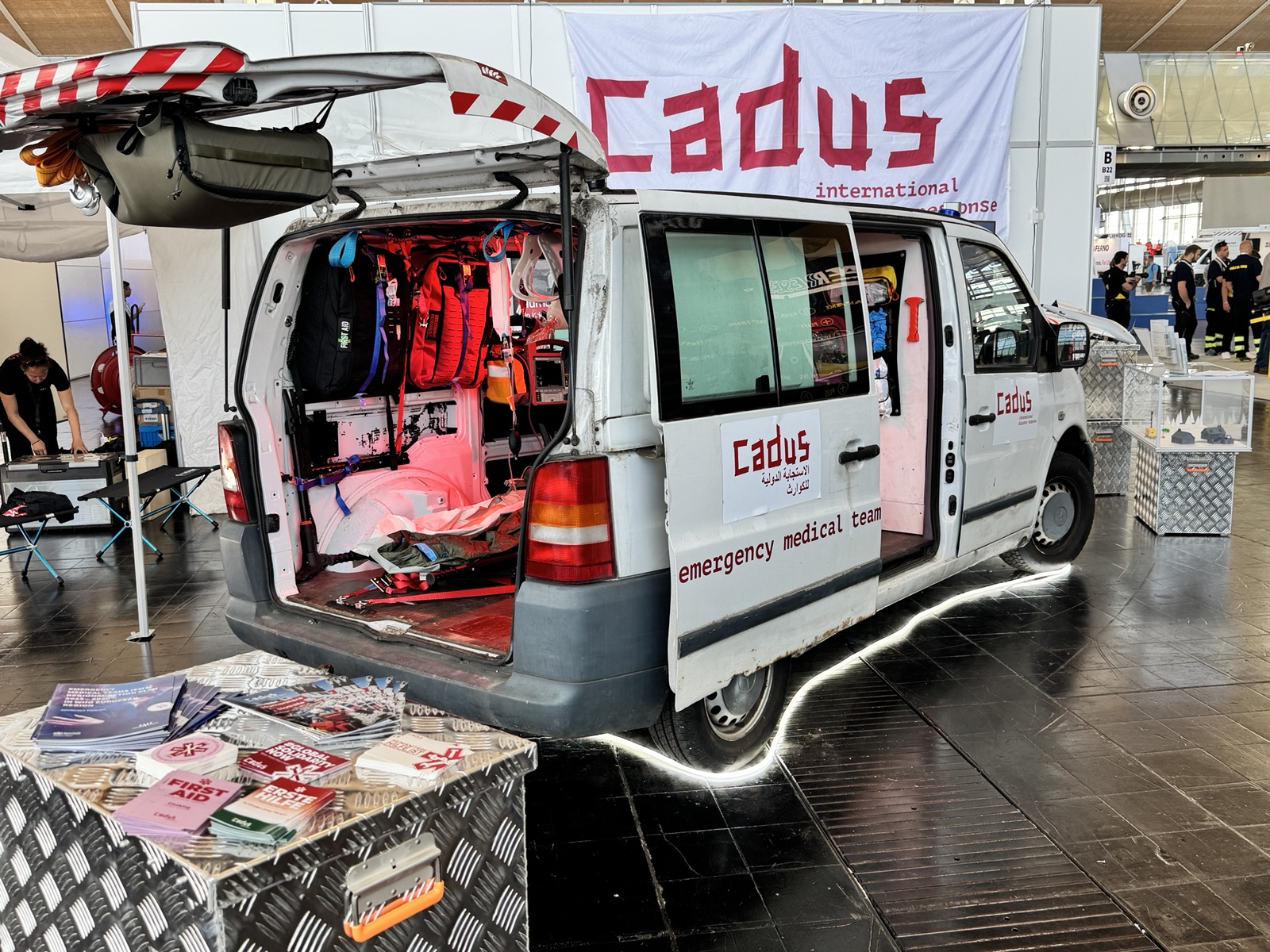
With a DIY solution, we are bringing a piece of reality from our humanitarian response in the war zone to the international trade fair. In this article our Managing Director Sebastian Jünemann explains why this is necessary.
Every 5 years, the “Interschutz” takes place in Hanover: the world’s leading trade fair for fire departments, rescue services, civil protection and safety. This year we will be exhibiting for the first time. Not as a commercial exhibitor (“for-profit”), but as an NGO by special invitation.
As always, the latest of the new is presented at Interschutz: Shiny high-tech equipment in all its glory and everything that medical and technical emergency personnel would want in an acute crisis. We are also looking forward to seeing what is currently the “top end” of what is possible.
And what are we exhibiting at our stand?
A dented, rusty van that was provisionally converted into an ambulance in a very short space of time. And for a very good reason.
Repairing instead of buying
To understand why, we need to take a brief look at the history of CADUS. Back in 2016/17, we began converting a decommissioned, old THW all-wheel drive truck into a mobile hospital for Rojava in north-east Syria. We didn’t reinvent the concept of the “mobile hospital” back then or develop anything groundbreaking. On the contrary: we took a very pragmatic approach based on existing solutions on the market.
So why didn’t we simply buy these existing concepts?
The answer is simple: brand-new concepts are incredibly expensive. In addition, hardly anyone can repair a complex new truck on site in a war zone (a so-called low-resource setting) and not least because such vehicle concepts are not kept in stock, but are only ever built to order. In addition to the lack of sustainability due to the lack of repair options and the costs, there is also a long waiting time, during which we ourselves have long been able to take action in our own makerspace in Berlin.
How humanitarian aid has changed
But let’s first take a step further towards the present in CADUS history: Mosul 2017, where we were deployed with our Mobile Hospital and operated a so-called Trauma Stabilization Point. We stabilized severely wounded patients to the point where they were medically fit for transport to the nearest hospital.
Ambulances were in short supply at the time. However, they were purchased by the World Health Organization (WHO) with available funding from elsewhere in the world, brought to Mosul and distributed to organizations there. That was less than ten years ago, and yet from today’s perspective it is hard to imagine how comparatively simple it was back then.
We are also currently seeing, for example during our deployment as an emergency medical team in Gaza, that free access for humanitarian goods and fuel in crisis regions can no longer be taken for granted.
The WHO was already looking for concepts for “ambulance conversion” during the Covid pandemic. For some of the reasons already mentioned above.
At the beginning of the full-scale Russian invasion of Ukraine, we saw that even the prices for used ambulances skyrocketed. We witnessed first-hand how people once again saw the opportunity to capitalize on other people’s suffering and tried to sell even dilapidated ambulances to Ukraine at completely inflated prices.
More disasters, less money
Speaking of Ukraine: as ambulances for intensive care transport were becoming scarce (or outrageously expensive) while a large number of patients needed to be cared for at the same time, we implemented another conversion project in 2023. We converted a second-hand coach into a mobile intensive care unit (MICU) that can transport four ventilated patients at the same time. The open source documentation of the innovative part of this project can be found here:
https://www.appropedia.org/Tolocar/MICU_Mobile_Intensive_Care_Unit
But we also have two other reasons for our exhibit at Interschutz: worldwide, available funding for humanitarian aid has fallen dramatically in recent years, while the number of crises and disasters has increased massively. And as you may know, little money and greater need are a difficult combination.
The lessons learned in Ukraine also provide a final reason for our exhibition at Interschutz: ambulances and humanitarian aid workers are increasingly being deliberately targeted by state actors such as Russia. Regular ambulances can hardly move in the frontline area without running the risk of being attacked by drones. As a result, grassroots organizations now prefer to use decommissioned armored personnel carriers for evacuations instead of used ambulances in order to have at least a minimum level of passive protection thanks to the armouring.
So when visitors come to our stand at Interschutz from June 1 to 6, we want our van to send a clear message among all the shiny, colorful metal: The “state of the art” of the industry is simply not available to the majority of people in this world, precisely because they wake up to an existing disaster every day.
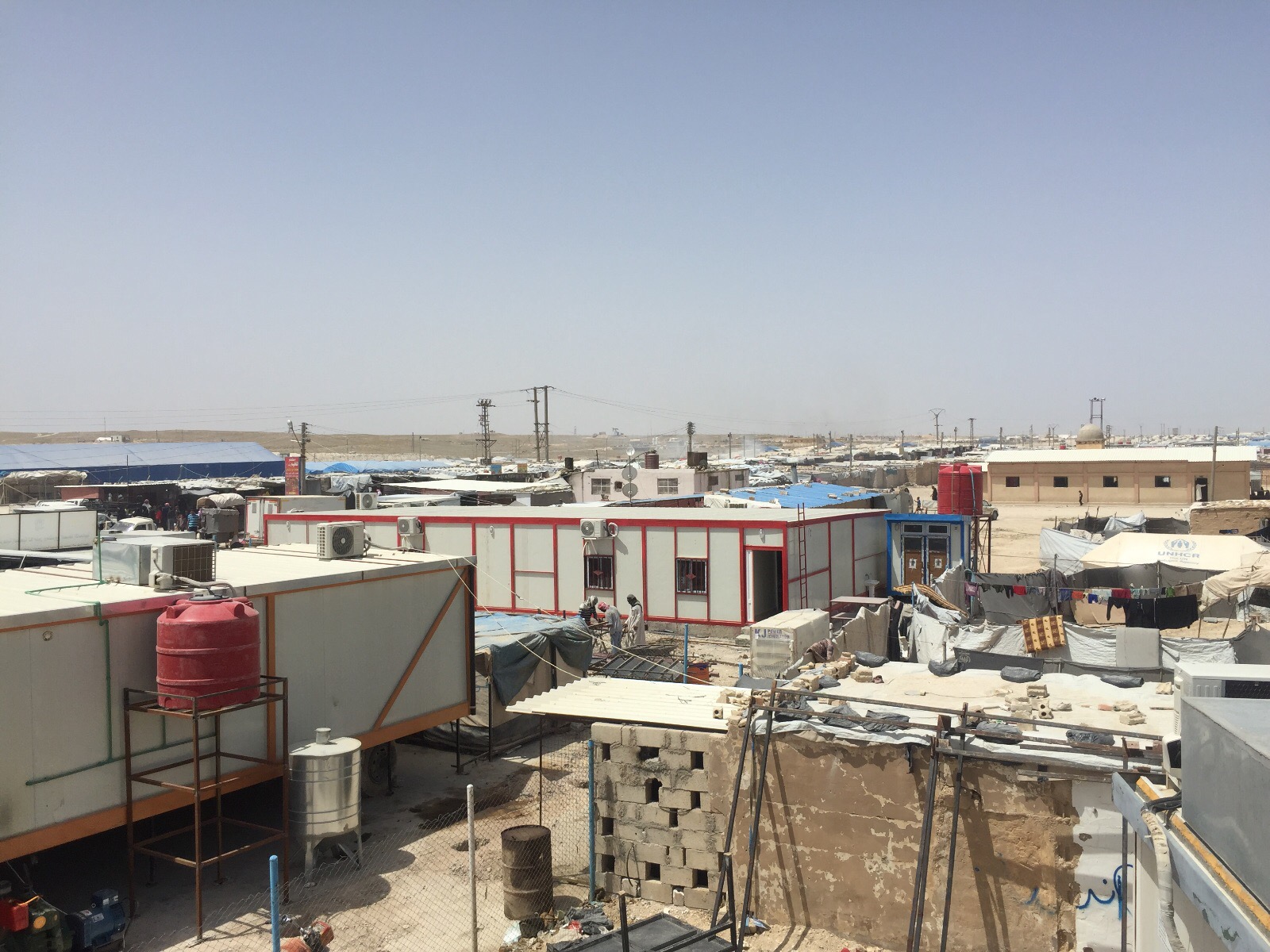
Syria: Former CADUS field hospital in al-Hol burnt down
After the Kurdish security forces withdrew from the al-Hol camp due to battles with Syrian government troops, violent unrest broke out inside the camp. An interview about the situation on the ground with Adrian, an employee of the organization Sîler.

The climate catastrophe as the greatest challenge for humanitarian aid
What impact does the climate catastrophe have on humanitarian aid? What can and must humanitarian actors prepare for and how must they adapt in order to counter the consequences of the climate catastrophe?
The future of humanitarian aid
Writing a text about the future of humanitarian aid. My first impulse: this is going to be a gloomy text. The present of humanitarian aid leaves little room for optimism. Wars continue, people are dying in Sudan unnoticed by the