CADUS goes Interschutz: Why we exhibit rust and dents instead of high-tech
Published on 1. June 2026
from Sebastian Juenemann
IMG_3088
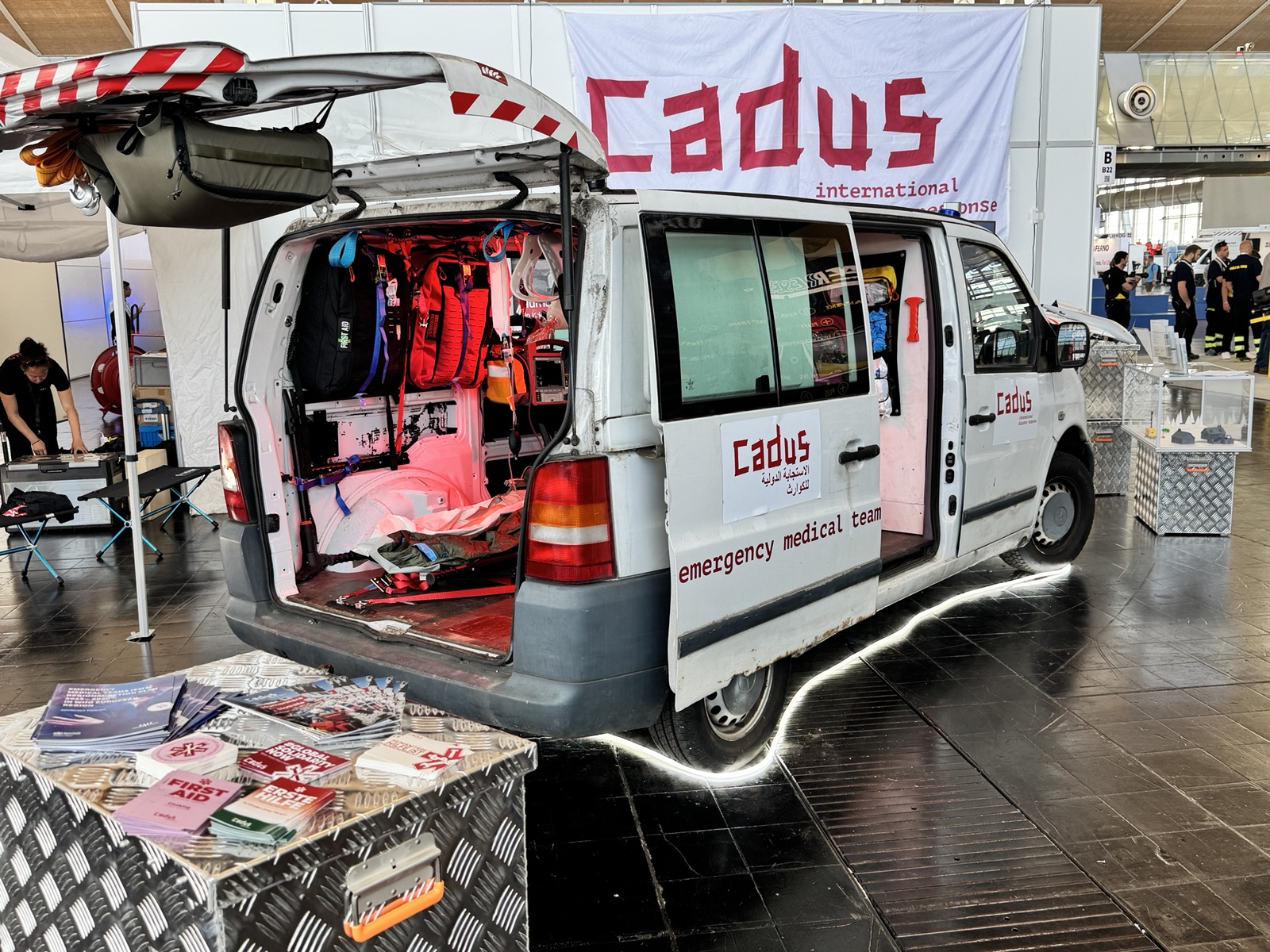
With a DIY solution, we’re bringing a slice of reality from humanitarian work in war zones to the international trade fair. Our CEO, Sebastian Jünemann, explains why this is necessary in this article.
Every five years, Hannover hosts “Interschutz,” the world’s leading trade fair for firefighting, emergency medical services, civil protection, and public safety. This year, we’re participating as exhibitors for the first time. It should be noted that we’re not participating as a commercial (“for-profit”) exhibitor, but as an NGO by special invitation.
As always, Interschutz showcases the very latest innovations: shiny, high-tech equipment in all its glory, and everything medical and technical emergency responders could hope for in a critical crisis. We, too, are looking forward to seeing what currently represents the “top end” of what’s possible.
And what are we exhibiting at our booth?
A dented, rusty van that was provisionally converted into an ambulance in a very short space of time. And for a very good reason.
Repairing instead of buying
To understand this reason, we need to take a brief look at CADUS’s history. As early as 2016–2017, we began converting a decommissioned, old THW four-wheel-drive truck into a mobile hospital for Rojava in northeastern Syria. We didn’t reinvent the “mobile hospital” concept back then, nor did we develop anything groundbreaking. On the contrary: We took a very pragmatic approach, drawing on existing solutions on the market.
So why didn’t we simply buy these existing concepts?
The answer is simple: Brand-new vehicle designs are incredibly expensive. On top of that, hardly anyone can repair a complex, new truck on-site in a war zone (a so-called low-resource setting), and not least because such vehicle designs aren’t kept in stock but are always built to order. So, on top of the lack of sustainability due to limited repair options and the high costs, there’s a long wait—during which we could have been up and running in our own makerspace in Berlin long ago.
How humanitarian aid has changed
But let’s first take a step closer to the present in CADUS’s history: Mosul, 2017.
We were deployed there with our Mobile Hospital and operated what is known as a Trauma Stabilization Point. We stabilized the most critically injured patients medically to the point where they were at all transportable to the nearest hospital.
Ambulances were in short supply at the time. However, they were purchased by the World Health Organization (WHO) with available funding from elsewhere in the world, brought to Mosul and distributed to organizations there. That was less than ten years ago, and yet from today’s perspective it is hard to imagine how comparatively simple it was back then.
We are also currently seeing, for example during our deployment as an emergency medical team in Gaza, that free access for humanitarian goods and fuel in crisis regions can no longer be taken for granted.
The WHO had already been looking for strategies for “ambulance conversion” during the COVID-19 pandemic, for some of the reasons mentioned above.
At the beginning of the full-scale Russian invasion of Ukraine, we saw that even the prices for used ambulances skyrocketed. We witnessed first-hand how people once again saw the opportunity to capitalize on other people’s suffering and tried to sell even dilapidated ambulances to Ukraine at completely inflated prices.
More disasters, less money
Speaking of Ukraine: Since ambulances for intensive care transport have become scarce (or outrageously expensive), while at the same time a large number of patientsSince we needed to provide care indoors, we carried out another conversion project in 2023. We converted a used tour bus into a mobile intensive care unit (MICU) capable of accommodating four patients on ventilators can be transported simultaneously. The open-source documentation for the innovative part of this project can be found here:
https://www.appropedia.org/Tolocar/MICU_Mobile_Intensive_Care_Unit
But we also have two other reasons for our exhibit at Interschutz: worldwide, available funding for humanitarian aid has fallen dramatically in recent years, while the number of crises and disasters has increased massively. And as you may know, little money and greater need are a difficult combination.
The lessons learned in Ukraine also provide a final reason for our exhibition at Interschutz: ambulances and humanitarian aid workers are increasingly being deliberately targeted by state actors such as Russia. In areas close to the front lines, regular ambulances can barely move without running the risk of being attacked by drones. As a result, grassroots organizations now prefer to use decommissioned armored cash transport vehicles rather than used ambulances for evacuations, so that the armor provides at least a minimum level of passive protection.
So when visitors to Interschutz stop by our booth from June 1 through 6, our van will send a clear message amid all that sparkling, colorful metal: The industry’s “state-of-the-art” technology is simply not available to the majority of people in this world—precisely because they wake up every day to an ongoing disaster.
Swiftwater Training – Two Testimonials
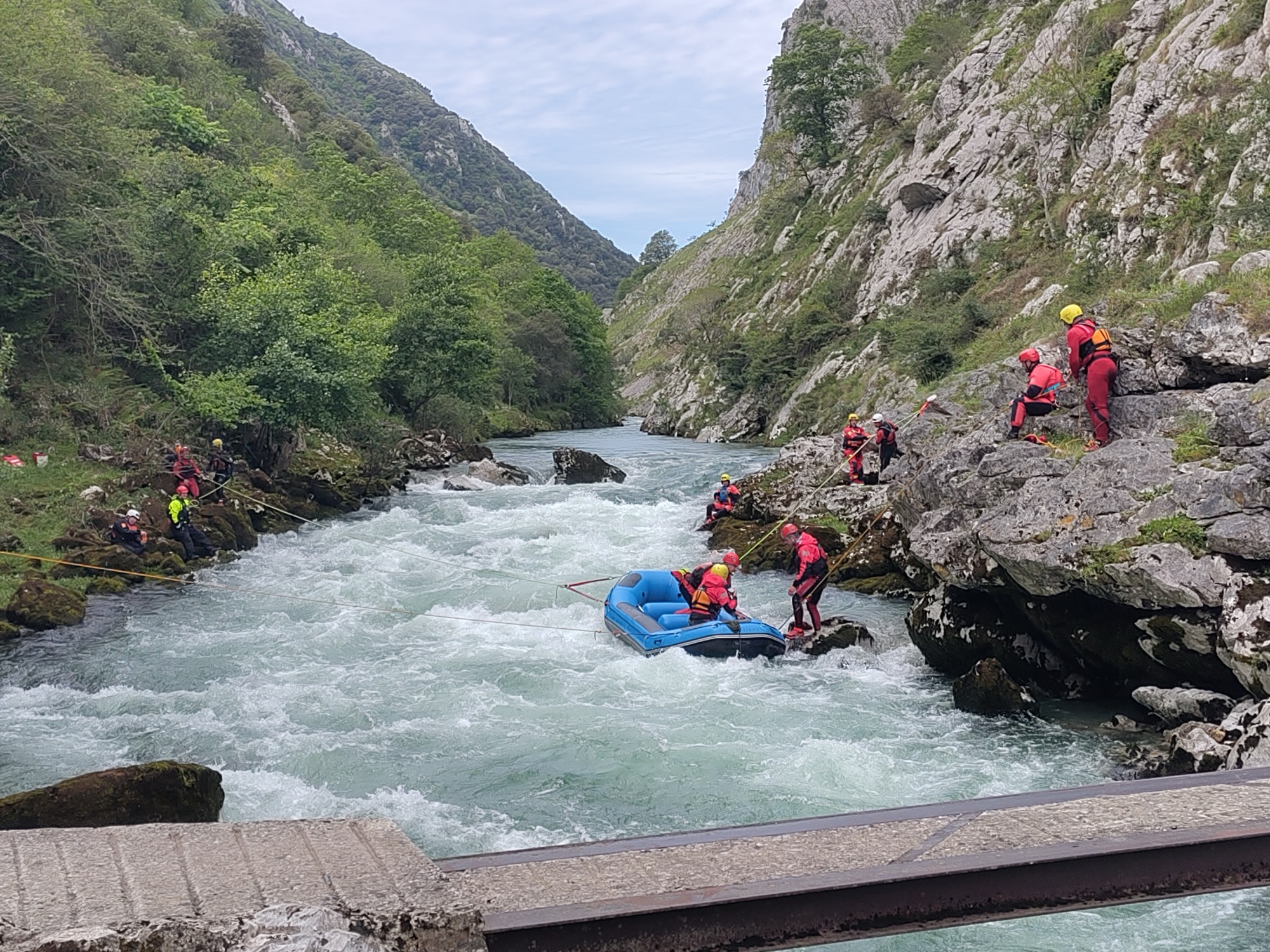
As a result of climate change, extreme weather events and flooding will increase worldwide. As part of our Climate Emergency Responder program, four CADUS volunteers therefore participated in a training course for instructors in current rescue. Sanne and Laura share their experiences with whitewater here.
Meet our Team: Dr. Corinna Schäfer
The reality of today’s crisis response operations involves more than just providing medical care in makeshift tents. It consists largely of logistics, infrastructure, and—increasingly—cybersecurity. This is exactly what our colleague Dr. Corinna Schäfer is working on. She tells us what drives her and how she came to join CADUS.

Shelter Diary
The people of Ukraine are under constant threat of the drone and missile attacks from the Russian military. Residential areas and civilian infrastructure are repeatedly targeted, and there are regular reports of deaths and injuries. Our teams, too, must deal with this danger. In the following brief excerpts, one of our staff members describes her experiences over the past few days.