One year field hospital al-Hawl
Published on 19. June 2020
from CADUS-PR
one-year-field-hospital-al-Hawl-feature-al_hol_juni20-f4d69879
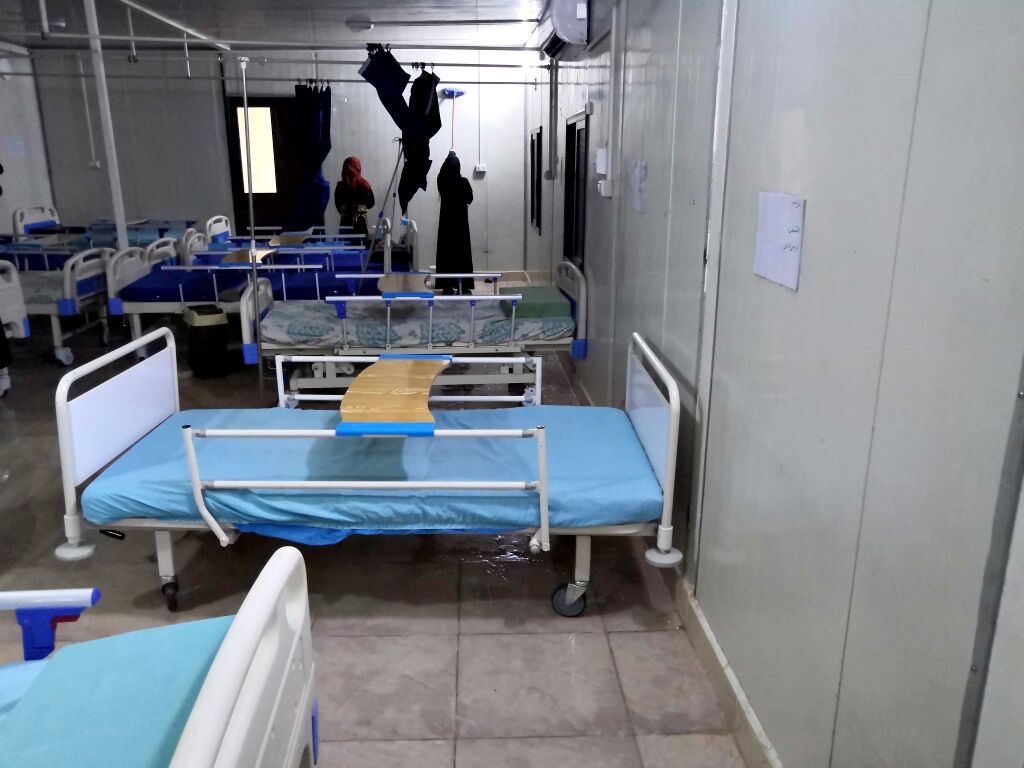
One year ago, together with our local partners from the Kurdish Red Crescent, we opened the field hospital in Al Hol, a refugee camp in northeastern Syria. We are looking back at an eventful year for us, our employees and our partners.
With the takeover of the hospital with three wards and an operating theatre, we also had the task of increasing capacity. In addition to training and the expansion of the team, this also required a further expansion of the hospital. In September 2019 the new wing of the hospital could be put into operation. This part supplemented the hospital with an X-ray room, an examination room, a small isolation ward, a pharmacy, an emergency room and another bed room. Altogether the field hospital offers 29 beds to treat patients from the camp.
Parallel to the hospital, an operation desk for medical emergencies was set up. This centre coordinates the ambulances in the camp and organises the transfer of patients within the camp, to hospitals and to specialists outside.
One year field hospital in Syria: The cycle of problem and solution
However, the work this year was not always without problems. In October 2019, the Turkish military offensive against Northeast Syria significantly worsened the humanitarian situation. We had to withdraw the international team during this time, but thanks to the great commitment of our local staff, the hospital was able to continue to operate the whole time.
The U.N. Cross-Border Resolution in January then resulted in our funding being cut off. Fortunately, a solution to this problem was found and the work could be continued.
But only a short time later the next difficulty came with COVID-19. The most direct effects were the international travel restrictions, which meant that no new medical personnel from abroad could join the project. Despite the closed borders and difficult supply routes, the hospital was still able to make the necessary preparations to care for possible COVID-19 patients until suitable special clinics were available.
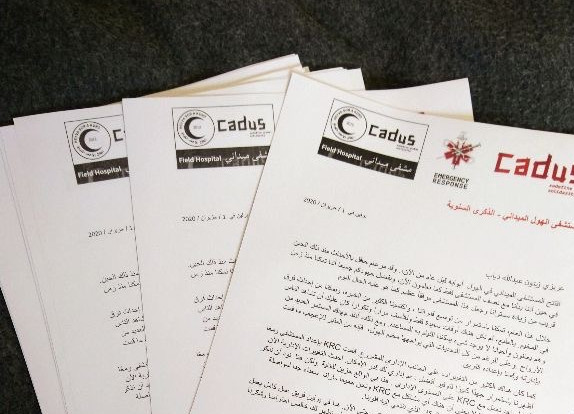
A small greeting and thanks from Berlin to our staff in the field hospital. ©CADUS
To another year
One year after opening, we can therefore look back on an eventful time. But there is no time to rest, because there are always new challenges and small things need to be improved.
We are pleased to be able to contribute to the medical care in Al Hol for another year together with our entire local team.
Published
Author: by Jonas Grünwald
The climate catastrophe as the greatest challenge for humanitarian aid
What impact does the climate catastrophe have on humanitarian aid? What can and must humanitarian actors prepare for and how must they adapt in order to counter the consequences of the climate catastrophe?
The future of humanitarian aid
Writing a text about the future of humanitarian aid. My first impulse: this is going to be a gloomy text. The present of humanitarian aid leaves little room for optimism. Wars continue, people are dying in Sudan unnoticed by the
How AI Is Changing Humanitarian Aid: Risks and Opportunities
I’ve spent enough nights under mosquito nets and sat through long, often circular UN coordination meetings to know this: if we want to reach people in crisis faster, with less waste, and without burning out the sector, we can’t